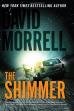
David Morrell
BIO
The father of the modern high-action thriller, David Morrell is the award-winning author of First Blood, the novel in which Rambo was created. He holds a Ph.D. in American Literature from the Pennsylvania State University and taught in the English department at the University of Iowa.
"The mild-mannered professor with the bloody minded visions," as one reviewer called him, Morrell is the author of 28 books, which include such bestsellers as THE BROTHERHOOD OF THE ROSE (the basis for a top rated NBC miniseries), THE FIFTH PROFESSION, and EXTREME DENIAL (set in Santa Fe, where he lives).
Noted for his research, Morrell is a graduate of the National Outdoor Leadership School for wilderness survival as well as the G. Gordon Liddy Academy of Corporate Security. Co-president of the International Thriller Writers organization, he is also an honorary lifetime member of the Special Operations Association and the Association of Former Intelligence Officers. He has been trained in firearms, hostage negotiation, assuming identities, executive protection, and defensive/offensive driving, among numerous other action skills that he depicts in his novels. With more than eighteen million copies of his books in print, his fiction has been translated into 26 languages.
Learn more about David Morrell by visiting his website at www.DavidMorrell.net.
Visit CREEPERS online at: www.theparagonhotel.com.
INTERVIEW
July 10, 2009
Though perhaps best known as the creator of Rambo, David Morrell has written over 30 works of fiction and nonfiction, including THE SPY WHO CAME FOR CHRISTMAS, SCAVENGER, CREEPERS and THE SUCCESSFUL NOVELIST. In this interview with Bookreporter.com's Joe Hartlaub, Morrell discusses the real-life inspirations behind the unusual visual phenomena that take place in his latest book, THE SHIMMER, and elaborates on one of its smaller themes of media sensationalism. He also describes how he worked his fascination with actor James Dean into the story, explains how he overcomes bouts of writer’s block, and reveals how screenwriter Stirling Silliphant prompted him to jumpstart his writing career.
Bookreporter.com: Your new novel, THE SHIMMER, is set in the fictional town of Rostov, Texas, where a visual phenomenon consisting of mysterious, nocturnal lights has occurred on an intermittent basis for well over a century. What made you decide to write about the lights? How did you first hear about them?
David Morrell: Five years ago, I read an item in the travel section of my local newspaper, the Santa Fe New Mexican. It described mysterious lights that appear on an almost nightly basis outside a town in west Texas called Marfa. The lights have been witnessed as long ago as 1889 when a rancher first brought a herd of cattle to the region. He worried that the lights were the campfires of marauders from Mexico, but after a fearful night, he couldn’t find any evidence of fires. Moreover, campfires don’t drift back and forth and up and down. In World War I, the lights represented a different fear --- that Germans in Mexico would be mobilizing to invade the United States. The long-term mystery of the lights appealed to me as a subject for a novel, but even more interesting was the way that the lights emphasized the emotions of the people who saw them. That finally became my subject --- that the lights would be mirrors of who each of us is.
BRC: You did a great deal of research into the Marfa Light phenomenon in preparation for writing THE SHIMMER. Based upon that research, what do you believe the lights to be? A weather-related phenomenon? A geothermal reaction? Hysterical suggestion? Or something else?
DM: I love doing research. If a subject doesn’t have something that I learn from, I don’t want to write about it. In this case, the research was fascinating. It’s important to emphasize that there are many places in the world that have mysterious lights, but most are easily explained by swamp gas or ball lightning, etc. The Marfa lights, however, resist explanation. Many scientists have studied them, using sophisticated equipment, but their best theories seem a stretch. One is that the sun heats quartz crystals in the soil, contracting them. At night, as the crystals cool and contract (the theory goes), they give off an electrical discharge. Another explanation is that temperature inversions in the atmosphere cause distant lights to be refracted. I’m not persuaded.
BRC: The lights serve as a converging point for a military officer whose family has been obsessed with the lights for generations, a married couple whose relationship has been slowly slipping away, and a self-absorbed television anchorman whose ego is matched only by his single-minded ambition. Col. Warren Raleigh is the latest in a familial line of career military men whose lives have been affected by the Rostov lights. Raleigh seems to have been predestined to have an encounter with the lights that will end with either his control of them or his destruction by them. I thought that your portrayal of Raleigh, and his ancestors, was one of the most challenging aspects of THE SHIMMER. Did you model Raleigh and his family after anyone in particular, or is he part of a fictitious archetype that you have been developing?
DM: Raleigh and his ancestors are a way for me to dramatize how powerfully the lights can obsess someone. His family’s story dates back to the First World War and the fear that the lights were Germans about to invade. Then I leap to the Second World War, when a military base was actually built near Marfa. The base (an air field) was abandoned in 1945, but its ruins are still there, and I couldn’t help thinking that the scare from the First World War could have spread to the Second World War and that a military family could be connected to both as well as to the present. I live in Santa Fe, New Mexico, not far from Los Alamos where the atomic bomb was developed in the Second World War. The scientists at Los Alamos, encouraged by the military, are always trying to find new weapons. I kept wondering what would happen if someone tried to weaponize the lights and what would happen to that person if the lights mirror who we are.
BRC: Dan and Tori Page play an extremely important part in THE SHIMMER. When Tori abruptly leaves their marital home in Santa Fe, New Mexico, Dan follows her, not entirely sure what is wrong but hoping to make things right. You could have written an excellent adventure novel by focusing on the military interest in and the television reporting of the Rostov lights, yet you made the book even deeper by using the lights as a symbol of an emotional tipping point of a relationship that might or might not be saved. How did the Pages creatively evolve for you while you were writing THE SHIMMER?
DM: Dan and Tori Page are the core of the book. Lately I’ve been thinking a lot about my own marriage, which has lasted 44 years and how I love my wife more fully with each of those years. I wanted to use Dan and Tori’s marriage as the heart of THE SHIMMER and to put them through a crisis that tests how they feel about one another. At the start, their marriage is falling apart because they forgot why they wanted to be married. At the end, Dan surrenders his soul to Tori, giving her unconditional love. The book has a strong spiritual and emotional content.
BRC: Brent Loft is another interesting character in THE SHIMMER. He is a television anchorman who regards each job and each co-worker as another rung to be stepped on as he makes his way up the career ladder. His particular story is almost like a parable. Did you intend this, or see it that way as you were writing the book?
DM: I knew that the media, particularly television, needed to be part of the story. A gunman starts shooting at the lights, screaming “Go back to hell where you came from!” Then he starts shooting at a crowd watching the lights and kills 20 people. In life, the media would seize on this event, and I wanted to dramatize how that would happen, how the media can influence the events they are reporting. Brent Loft is my focus on this aspect of the story. He uses the massacre as a way to move up the broadcast ladder. He so sensationalizes the mass murder, linking the deaths to the lights, that thousands of curiosity seekers converge on the area, ultimately leading to a greater disaster. It would have been easy to make Loft seem a villain, but what I wanted to do instead was to surprise the reader by showing how the lights bring out qualities in him that no one could have expected. The relationship between him and his female camera operator is meant to be a parallel to the relationship between Dan and Tori Page. Loft and Anita bond so closely that Loft eventually risks his life for her. In the end, he is almost tragic in the way that he learns to be a better person and then is destroyed.
BRC: Rostov is based upon an actual place --- Marfa, Texas --- which is known for the “Marfa lights,” a phenomenon that has been reported there not only by local residents but also, interestingly enough, by the late James Dean, who became entranced with the lights while Giant, a movie regarded by some as his masterpiece, was filmed in Marfa. Did Dean have experiences similar to those of James Deacon, the fictitious actor whose experiences with filming a movie in Rostov are recounted in THE SHIMMER?
DM: I’m fascinated by James Dean’s background, in particular how he died before realizing how big a star he was. When Giant was filmed in Marfa, he was entranced by the lights and took his co-stars Elizabeth Taylor and Rock Hudson to see them, along with Giant’s director, George Stevens. But they couldn’t see the lights. Only Dean could. This is another puzzling aspect of the lights. Two friends could go to see the lights, but on any night, the first friend would see them while the other would not. On another night, the second friend might be the one to see them while the first friend would not. A few days after finishing his work on Giant, Dean was killed in a car accident. I wanted to put some of his experience into THE SHIMMER, using a character I call James Deacon. The book is about how we perceive reality, and one object that illustrates that theme is the ranch house set that was built for Giant, which I call Birthright. In the movie, that house looks as solid as the mountains in the distance, but in reality, it was a façade; the novel asks, “What’s behind the façade?”
BRC: You have indicated elsewhere that the television series “Route 66,” and the quality of the scripting of that program, initially sparked your interest in writing. I was a fan of the show myself, and I felt while reading THE SHIMMER as if perhaps the series influenced the book in some way. Part of the story concerns a couple --- Dan and Tori Page, who visit a city off the beaten path and whose interaction with the residents changes things irrevocably for everyone concerned. I don’t know if it was the wide open spaces of the setting or something else, but there were times I felt that I could almost see Tod Stiles and Buz Murdock just off to the side of what was happening in the book. Was “Route 66” on your mind at all when you wrote THE SHIMMER? And have any of your other novels served as a subtle homage to the series?
DM: Stirling Silliphant’s brilliant scripts for “Route 66” made me decide to be a writer when I was 17. At the time, I sent him a letter, telling him so, and he encouraged me. Eventually, we worked together when Stirling was the executive producer for the NBC miniseries of my novel THE BROTHERHOOD OF THE ROSE. His scripts are characterized by a tremendous amount of action coupled with ideas --- opposites coming together. The theme of “Route 66” is that the journey matters more than the destination, and that is how I’ve led my life. It’s also an important element in my work. It’s very easy to imagine that THE SHIMMER was an extension of that classic television series. As you say, Dan and Tori visit a town off the beaten track where things change irrevocably for everyone concerned. That’s something Stirling liked to write about.
BRC: You have not only created an American icon --- Rambo --- but have become in literary circles an iconic figure yourself. Yet, well into your fourth decade of writing, some of your most recent work is also some of your best. In fact, you seem to be entering a new phase of your literary career. What keeps you going, keeps you motivated, after all you have accomplished?
DM: The other day, I was amazed to realize that I’ll soon enter my fifth decade as an author. I think one reason I lasted so long is that while all my books have action and suspense, each takes its own direction. I treat each book as a special project. Before beginning, I write a letter to myself, asking “Why is this novel worth a year of my life?” I’d better have a damned good answer before I proceed. As for my motivation, I guess I’m still trying to be Stirling Silliphant. He was unbelievably creative and energetic. He remains my role model. Plus, all these ideas for stories keep popping into my head. I can’t sleep at night unless I write them down.
BRC: On a related note, how do you keep your expression of your ideas so new and so fresh? Is it an ability that comes naturally to you, or is redundancy something that you occasionally find creeping into your work so that you have to work to avoid it?
DM: I have a morbid fear of repeating myself. Hardly a day goes by when I’m not asked to write another novel in The Brotherhood of the Rose series. But that series came out of the writer I was in the 1980s. Twenty-five years later, I’m a different person, addressing new imaginative horizons and trying to relate to a vastly different world.
BRC: What do you do when you are not writing or not researching? What non-writing activities do you utilize to recharge your creative batteries?
DM: Believe it or not, Rambo’s father is an avid vegetable gardener. I enjoy swimming, tennis and hiking, particularly in the mountains outside Santa Fe. The research for my books is very battery charging. I’m always learning new skills and new ways of seeing things (the latter is a big theme in THE SHIMMER). I once lived in the Wyoming mountains for 35 days. For one of my novels, I learned how to race cars and do the spins, etc. that you see in the movies. For the aircraft sequences in THE SHIMMER, I became so engrossed in the research that eventually I earned my private pilot’s license. Next, I’d like to learn to sail.
BRC: In your afterword to THE SHIMMER, you discuss your idea files, as well as the fact that the concept for the novel lay dormant for you for a while before you revisited it and completed the book. How often do you begin projects that ultimately don’t seem to go anywhere at first? And have you had any ideas that you, regrettably, have totally given up on as being unworkable?
DM: The 100-page mark is a big deal for me. Even after I write a long letter to myself in which I discuss all the elements I think will be in the story, I can fool myself. I have three projects that sit in a drawer, never proceeding past the 100-page mark because I couldn’t sustain my interest or because I uncovered a serious flaw.
BRC: You are known not only as a prolific author but also as a vociferous reader. What have you read in the past six months, in any genre, that you would recommend to our readers?
DM: I’ve been revisiting favorites that influenced me but that I haven’t read in decades. James M. Cain’s THE POSTMAN ALWAYS RINGS TWICE. Geoffrey Household’s ROGUE MALE. Thomas Tryon’s THE OTHER. William Goldman’s MARATHON MAN. Goldman in particular has a lot of technical flourishes --- elements of punctuation, for example --- that I’d like to explore.
BRC: Writer’s block is a problem that is shared by aspiring writers and seasoned authors alike. Has it ever been a problem for you? If so, how do you break through it?
DM: There are two reasons for writer’s block. One is that the story hasn’t been thought through properly, that there’s a flaw in the concept that the writer doesn’t realize and that makes the story a struggle. The other reason is that there is some element in the story that the author can’t subconsciously deal with. Over the years, both have happened to me. When a story gets to be tough sledding, I always start looking for its flaw or else my own flaw.
BRC: What are you working on now, and when might readers expect to see it?
DM: In September, I have a novella “The Architecture of Snow” in an anthology, DARK DELICACIES 3. I feel it’s one of the best things I’ve written --- an eerie piece about modern publishing, about an editor and a recluse author who strongly resembles J. D. Salinger. Also, with Hank Wagner, I’m co-editing THRILLERS: 100 MUST READS, a collection of essays about 100 classic thrillers, such as Wilkie Collins’s THE WOMAN IN WHITE, John Buchan’s THE THIRTY NINE STEPS, and Brian Garfield’s DEATH WISH. The essay writers are some of the best living thriller writers, such as David Baldacci, Steve Berry, Sandra Brown, Lee Child, Lincoln Child, Jeffery Deaver, Tess Gerritsen, Heather Graham, John Lescroart, Gayle Lynds, Katherine Neville, Michael Palmer, Douglas Preston, James Rollins, R. L. Stine, and on and on. The book will be published in July of 2010, during ThrillerFest, the gala readers/writers festival of the International Thriller Writers organization.
Click here now to buy this book from Amazon.
INTERVIEW
March 23, 2007
Dubbed "the father of the modern action novel," David Morrell has written close to 30 books during the course of his 35-year career, including FIRST BLOOD, THE BROTHERHOOD OF THE ROSE and CREEPERS. In this interview with Bookreporter.com's Joe Hartlaub, Morrell explains why he chose to bring back the protagonists of his previous thriller for his latest work, SCAVENGER, and describes the research he conducted to accurately portray the nooks and crannies of New York City. He also discusses the various creative directions his novels have taken over the years and shares details about several projects he's currently working on.
Bookreporter.com: SCAVENGER is nominally a sequel to CREEPERS, given the return of Frank Balenger and Amanda Evert. It is quite different from CREEPERS in many ways. CREEPERS was confined to one location, while SCAVENGER is painted on a cross-country canvas. When you first conceived CREEPERS, did you anticipate bringing Balenger and Evert back for a second book? And do you have any plans for them to return yet again, either as primary or secondary characters?
David Morrell: I've written few sequels and initially didn't intend for SCAVENGER to be a follow-up to CREEPERS. But the plot insisted that Balenger and Amanda return. The book is about a desperate hunt for a lost 100-year-old time capsule. The people involved in the hunt are forced to participate and are selected because they have proven themselves to be world-class survivors: two mountain climbers who survived a harrowing ordeal on Mt. Everest, a woman who spent two weeks in a lifeboat on the Pacific Ocean, a Marine aviator who was shot down and then pursued by Iraqi insurgents for 10 days. What happened to Balenger and Amanda in the abandoned Paragon Hotel qualifies them as survivors on that scale. Whether I put them in yet another book depends on whether I can find the right plot for them. They've certainly been through a lot. I don't want to be sadistic. And yet I'm fascinated by Balenger's need to escape into the past.
By the way, you mentioned that CREEPERS has one location while SCAVENGER has a cross-country canvas. One of my goals was to move from the claustrophobia of the first one to agoraphobia in the second. As a character notes in SCAVENGER, Hitchcock made North by Northwest so that he could do his best to create fear in wide-open spaces in daylight.
BRC: A good deal of SCAVENGER is set in New York's Greenwich Village. When visiting that neighborhood, one tends to forget that many of the buildings there have existed for over a century, and have nooks and crannies that haven't been examined in decades --- at least until Frank Balenger came along. What was involved in gaining access to some of those buildings while you were writing SCAVENGER?
DM: A couple of years ago, I was at Peter Straub's house on New York's Upper West Side. It's an old brownstone, and at one point he led me to the basement, which exuded the sense of age. He opened one of several cardboard boxes, searched inside and pulled out an old ledger, which to my surprise and delight turned out to be the original handwritten manuscript for GHOST STORY. Age seemed everywhere. I eventually used that old brick-lined basement in SCAVENGER, transporting it to a brownstone near Gramercy Park. I've been in similar old New York buildings. Basically, I moved the details from one location to another. Greenwich Village fascinates me because, during colonial times, it had the sweetest drinking water on the island as opposed to the brackish water that was in most of Manhattan. The first streets in Greenwich Village were built along streams, which is why the streets seem haphazardly arranged. Eventually the streets and houses were built over the streams, but some houses still had access to the water under them, a detail I use during a claustrophobic scene in SCAVENGER. To this day, if you want to build something in Greenwich Village, you need to get a map that shows where the streams were and perhaps still are.
BRC: The New York Public Library is another New York landmark that plays a primary role in SCAVENGER. While the Internet in general is an indispensable research tool, it is often forgotten that there is much that can be learned by rolling up one's sleeves and getting into the stacks such as Balenger did in SCAVENGER. While researching SCAVENGER, approximately how much of your time was spent utilizing Internet resources as opposed to hard copy research? Did you find that there was actually more to be found in a physical search than online?
DM: The Internet is a wonderful tool for gaining information, although I need to pretend I'm a newspaper reporter and get three verifications for supposed facts that I'm using. When writing SCAVENGER, I used the web to research the New York City locations, but then I went to New York and actually walked to every location and inspected it as best I could. At Gramercy Park and again at the New York City Public Library on 5th Ave. and 42nd St., I discovered that the Internet information was wrong. I should point out that, at the so-called main branch of the library, you can't get into the stacks. You fill out a card, and a librarian brings you the book you want. It's a huge, wonderful building, very evocative and filled with the sense of history.
BRC: You have been writing novels for over 30 years and have achieved some remarkable milestones, not the least of which has been the creation of John Rambo, an American icon. What personal goals, if any, do you have yet to accomplish?
DM: Each new book is a new start. This is my 35th year as a published author. I'm amazed by how fast the time went. I think one reason I've lasted so long is that I tried not to repeat myself. All the novels have action and suspense, but after that, each tends to take a different creative direction. The Brotherhood of the Rose series was about spies, for example. Later, I wrote two thrillers about artists --- DOUBLE IMAGE was about a photographer, and BURNT SIENNA was about a painter. With CREEPERS and SCAVENGER, I became interested in what I call eerie thrillers --- novels that have the moody tone of a ghost story, and yet there's nothing supernatural in them. I'm sure that another different type of thriller will occur to me. It's great fun taking various journeys.
BRC: SCAVENGER is perhaps your most interesting book to date, which, considering the length and breadth of your bibliography, is quite an accomplishment. It is very contemporary, given its focus upon video games, role playing, and the increasing presence of and reliance upon GPS units. Yet it has a "pulp fiction" feel to it as well, with a hero running into danger after danger, all the while attempting to rescue a damsel in distress --- kind of a Doc Savage meets Matt Bourne scenario. Given that you yourself have created one of America's most enduring icons, are there are particular authors, or fictional figures, that provided inspiration for you?
DM: SCAVENGER is definitely a high-action story, not quite Indiana Jones, but close. I wanted it to have a big adventurous feeling in the spirit of the obstacle race and scavenger hunt metaphors that motivated me to write it. There are a lot of contrasts --- the modern topics of video-game theory and GPS receivers in contrast with the theme of the past as exemplified by the 100-year-old time capsule. But at heart, I'm still heavily influenced by Joseph Campbell's THE HERO WITH A THOUSAND FACES, which I read in 1968 and I never got over. Myth and archetypes are disguised throughout my fiction. It may be these characteristics are what you feel when you mention a hero running into danger after danger while trying to rescue a damsel in distress. I feel strongly connected to the principles of ancient storytelling.
BRC: You describe yourself in the author's note to SCAVENGER as a packrat. I would like for you to look, right now, at the lower right hand corner of your desk and describe everything that you have stacked there.
DM:On the lower right section of my desk, I see a poster for a book signing that I did in New York City in 1996. Next to it is a compound bow leaning against the wall, the result of research into archery that I conducted in the mid-1980s. There are several book posters in tubes and an advertisement for a Rambo movie in the 1980s. On the left side of my desk, there are three huge shopping bags filled with corrected drafts of my last three projects. There is also a 3-D poster display (small) advertising the NBC miniseries of my novel THE BROTHERHOOD OF THE ROSE. But this doesn't quite communicate the chaos.
BRC: You published a collection of your short stories, BLACK EVENING, in 1999. Do you have any plans to issue a second collection in the near future?
DM: Actually, a second collection of stories, NIGHTSCAPE, appeared in 2004. In the U.S., a specialty publisher, Subterranean Press, handled it. One of these days, there will be a paperback. In the U.K., there was a mass market edition. I love the creative challenge of writing short stories, the compression and the chance to experiment with different approaches. In fact, I have enough stories for a third collection, but so many other projects are in the works that I don't know when I'll put that together.
BRC: You have already announced your next project, which I've heard described as an espionage novel set around the Christmas holiday. What other projects are you presently working on?
DM: Next year's book is called THE SPY WHO CAME FOR CHRISTMAS. It's a contemporary action espionage story that takes place on Christmas Eve in Santa Fe, New Mexico, where I live. Santa Fe is a major holiday destination for travelers. We have a mile long street called Canyon Road that has about 1,000 art galleries and is lit spectacularly for the holidays. The story takes place there. At one point, the main character, a spy, takes refuge in a home where he discovers that he has put a family in danger. As he prepares the house for a siege, he tries to calm the family by telling them the spy's version of the traditional Nativity story. I did a lot of historical research based on events in the New Testament. Readers will be surprised by the background I've uncovered. None of it is faith-threatening, but it does make the often-told traditional Nativity story more vivid. The book will probably have some illustrations, and that's in keeping with another new project, a six-part Captain America comic book series that I wrote. The first issue will probably appear in September. Eventually all six episodes will be collected in a book, for which I'll write an essay. It's a serious project that deals with the burden of being a superhero in today's troubled world, especially a superhero named after the United States. I do my best to make the reader believe that Captain America is a real character. There's a lot of emotion as well as action. I enjoyed learning a new way to tell a story.
BRC: SCAVENGER has much to do with time capsules. Have you, to your knowledge, had any of your novels placed in time capsules? And if you could pick one of your works to be placed in a time capsule, which one would it be?
DM: No one ever informed me that one of my novels was ever placed in a time capsule. I suppose FIRST BLOOD would be the book to include because Rambo became such an internationally iconic character. Indeed I was told by a Polish Solidarity demonstrator that she and her companions used to watch tapes of Rambo movies (which were illegal in Poland). Then they would dress up as Rambo, complete with the headband, and demonstrate against the government soldiers. In an odd way, she said, Rambo helped bring down the Soviet empire. Who'd have thought? But when we consider time capsules, we need to remember something I mention in SCAVENGER --- that two famous capsules (one in 1939 and one in 1940) both included copies of Margaret Mitchell's GONE WITH THE WIND. I wonder if they realized the irony of the title and its broader application: all societies eventually vanish, gone with the wind.
BRC: Are there any authors who have been of particular influence upon you? And what authors, of any genre, do you read for pleasure?
DM: When I started FIRST BLOOD back in 1968, I was deeply influenced by Geoffrey Household's ROGUE MALE, a 1939 thriller in which a British big-game hunter stalks Hitler on the eve of the Second World War. Part of its appeal is Household's use of forests and other natural locales as a backdrop to the action. I think of that book often and still love writing action scenes set in nature --- the mysterious Wyoming valley in SCAVENGER, for instance. I wrote my Master's thesis on the style of Ernest Hemingway and am very influenced by the techniques he uses to gain immediacy in his prose. Along with these two authors, the only other author whose work is totally represented on my book shelves is Dan Simmons. One reading problem I have is that I don't look at much fiction when I'm working on a book. Sometimes another author's style can be contagious. Mostly, when I'm involved in a project, I read nonfiction, most of it for research. Because I'm a co-founder of the International Thriller Writers organization (and its current co-president), I need to be circumspect about which authors I mention, lest I offend some by not mentioning them. However, I'll take a risk and include Stephen Hunter, whose POINT OF IMPACT is an amazing action book.
BRC: While you are primarily known for your works of fiction, you have also co-edited one and written three nonfiction works. Do you have any interest in writing another nonfiction book? If so, what topic interests you?
DM: For the International Thriller Writers, I'm going to co-edit (with Hank Wagner) a nonfiction project called THRILLER: 100 MUST-READS. We have a list of 100 classical thrillers about which contemporary thriller writers will write 900 words of appreciation. It's a very exciting project that will educate readers about how varied and ambitious thrillers can be.
BRC: You have been described as the father of the modern action novel. If you decided that you were going to stop writing tomorrow, what would your next vocational move be?
DM: For many years, I was a professor of American literature at the University of Iowa. I still enjoy teaching and do presentations at a dozen or so writers' conferences a year, so perhaps I would pursue that vocation again. At the same time, I'm fond of tennis, hiking and gardening, which can easily fill a day. Currently, I'm also taking flying lessons. There's always something new to explore.
Click here now to buy this book from Amazon.
INTERVIEW
November 4, 2005
Bookreporter.com's Carol Fitzgerald and Joe Hartlaub interviewed David Morrell, the award-winning author of FIRST BLOOD, the novel in which Rambo was created. In this interview, Morrell discusses his childhood hobby of exploring abandoned buildings as the basis for his latest work, CREEPERS, and sheds light on the historical rise and fall of New Jersey's Asbury Park as a symbol of the failed American Dream. He also elaborates on his use of Poe's theories about readers' attention spans and discloses a few details about his upcoming projects.
Bookreporter.com: CREEPERS takes place almost entirely in The Paragon Hotel, an abandoned hotel in Asbury Park, NJ. Did you base the Paragon on an actual building in Asbury Park? And what was it about Asbury Park that inspired you to set CREEPERS there?
David Morrell: There are numerous “classic” hotels that are abandoned in Asbury Park; the Paragon is an amalgam of them, plus some ideas from Frank Lloyd Wright. But the essence of the hotel's structure needed to be that it got smaller (in a sort of pyramid shape) as the urban explorers climbed higher and the tension increased.
As for Asbury Park, I'm intrigued by the area's failed hopes --- the collapse of the American Dream. It's almost mythic. Asbury Park was founded in the 1870s as a bastion of Methodism, but thirty years later, there was a huge gambling casino at the end of a half-mile boardwalk. In an amazing contrast, the town became known as the crown jewel of resorts on the eastern seaboard. A fire in the 1920s destroyed the resort area, and they rebuilt. In 1944, a hurricane destroyed the resort area, and they rebuilt. But how many times can you have the strength to keep going? By the 1960s, the place was a haven for bikers, street musicians, hippies, and drug dealers. A riot in 1970 destroyed the resort area, but this time it wasn't rebuilt. Bruce Springsteen played in some of the remaining bars, and his early songs about desperation and needing to head down the road are emblematic of the emotions of Asbury Park. Today, despite repeated attempts to refurbish the area, it looks like bombed-out Bosnia.
BRC: Creepers are also known as "urban spelunkers," people who explore abandoned and deserted buildings and tunnels. Your biographical information indicates that you used to explore deserted buildings as a child as a means to escape your home life. Did you always go alone or did you occasionally do this with others? What made you give up your explorations? When did you become aware that others were interested in this pursuit?
DM: I was always alone. That's the way I was raised, alone. I stopped exploring old buildings when my family moved to the outskirts of town. There weren't any abandoned buildings to examine. But I always still had the urge. Then a couple of years ago, I read an article in my local newspaper (in Santa Fe) and was astonished to learn that exploring abandoned buildings is now an underground cultural movement with rules (take nothing but photographs, leave nothing but footprints) and equipment (hardhats, cavers' lights, methane gas detectors). I did an internet search and found hundreds of thousands of contacts around the world. Wow. I knew it was a wonderful topic for a novel.
BRC: Did you engage in any creeping as part of the writing process of CREEPERS?
DM: I did not. The urban exploration sites on the Internet are so full of details and photographs that I felt I had more than enough information. At the end of CREEPERS, I list the Internet addresses for many of the main sites. They are very interesting. At one point, I sent emails, asking if I could go along on an expedition. No one ever responded, which is not surprising, as this can be an illegal activity. The explorers to whom I sent emails had no idea if I was who I claimed to be. Why would they incriminate themselves?
While I was writing the book, I did have a chance, legally, to enter my former high school, which has been sealed since 1980. It was eerie to walk along hallways that had once been full of life and that had now been ravaged by time and neglect. Strips of paint hung from the walls as if they had been clawed down by a giant rampaging animal.
BRC: Have you had any experiences similar to those encountered by Professor Conklin's group in CREEPERS? And what was the most unusual item you've discovered that you are able, or willing, to discuss?
DM: When I was very young, I found some old 78 rpm shellac records in an abandoned apartment building. One of them had a song, “Those Wedding Bells Are Breaking Up That Old Gang Of Mine.” I played it so often that I almost wore it out. My home life was so rotten (constant arguing between my mother and stepfather) that I fantasized about going back in time and being in the studio when the song was recorded. Only later did I realize how ironic the song's title was.
BRC: We love the concept that CREEPERS takes place in eight hours and can be read by readers in eight hours. What prompted you to come up with this concept? How did you time the eight-hour plan?
DM: I wanted CREEPERS to have an intense unity of time and place. From the start I decided that the goal was to get the characters into the abandoned Paragon Hotel as soon as possible and then to dramatize every instant of every breath of eight hours. No summaries, no cuts, no leaps forward. I absolutely loved the idea. Most of my novels tend to be structured so that a major section takes about one hour to read. (This is something I got from Poe, who theorized that an hour was the maximum time you can count on a reader's attention.) Based on my own experience of reading my manuscripts, it takes me about an hour to read 50 typed pages, so that became my method of timing it. I was delighted to learn that the unabridged Brilliance audio lasts eight hours.
BRC: You created an interesting website to promote CREEPERS. What can you tell readers about it?
DM: The website is www.theparagonhotel.com. It's a collaboration among my publisher (especially Elizabeth Whiting), my publicist daughter (Sarie), my Internet guru (Nanci Kalanta of www.horrorworld.org), and me. We started small, trying to make the viewer believe that the Paragon Hotel was a real place. Thus the first version of the site was nothing but a timeline for the hotel, with all the interesting things that happened there. We had photographs, and it was convincing. Then we added new pages in which images of ruin pop out of a glamorous hotel lobby. We had sections from the book. We had photographs of the way Asbury Park looked in its glory days, compared to how it looks now. There's a spooky image of a woman in a full bathing costume, probably taken in the 1910s, and she seems to have ectoplasm around her. The photo was perfect for the tone of the book. Then we added a one-minute animated trailer with sound --- almost as if it were a trailer for a movie. Afterwards, we added greeting cards and a “live” interview. You can explore the website the way you would the actual hotel. It's very cool. At the same time, there's a BE A CREEPER maze game over at www.horrorworld.org, and that's very cool also.
BRC: You have been writing novels for over 30 years, and have achieved some remarkable milestones, not the least of which has been the creation of John Rambo, a fictional icon. What personal goals, if any, do you have yet to accomplish?
DM: In my writing book, LESSONS FROM A LIFETIME OF WRITING, I tell a story about my wife and a child she met outside our home. The child was carrying drawings home from school, and he spread them on our lawn and told my wife the story behind each sketch. “This is my school, and these are my friends, and this is the playground.” Then he added, discouraged, “In my head, they were a whole lot better.” I have stories teeming in my imagination. With each novel, I hope to make the finished book the same as what's in my imagination. Each time, I get closer. Perhaps the day I achieve a complete match, that's when I'll stop.
BRC: You published a collection of your short stories, BLACK EVENING, in 1999. Do you have any plans to issue a second collection in the near future?
DM: Actually, in 2004, there was a second collection, called NIGHTSCAPE, and I now have almost enough material for a third collection, although I'm not sure when I'll put it together. So many other things are happening.
BRC: Are there any authors who have been of particular influence upon you? And what authors, of any genre, do you read for pleasure?
DM: When I'm working on a novel, I tend to read only nonfiction so that I'm not influenced by another fiction writer's style. My Master's thesis was about Hemingway's style, so I assume I was influenced by that. The thriller writer who got me excited about the possibilities of what goes into a thriller is Geoffrey Household, a British author most famous for ROGUE MALE (1939), a novel about a British big game hunter who stalks Hitler on the eve of WWII. He's caught on the first page, left for dead on the second, and by the third page, the pace really gets going. Much of the action takes place in a hole in the ground. I never got over reading it.
BRC: You, along with Gayle Lynds, recently founded the International Thriller Writers Association. What can you share with readers about this organization and its mission?
DM: Gayle and I thought it was time for an organization that would help writers and readers better understand the exciting potential of what thrillers can be. We also wanted to help our members find a greater readership. We've been in existence a little more than a year, and already we have more than 300 members (many of them New York Times bestsellers), with over 2 billion books in print worldwide. Next June, at the fabulous Arizona Biltmore Resort, we're going to have ThrillerFest, an exciting event for thriller authors and readers, in which such luminaries as John Lescroart, Brad Meltzer, Douglas Preston and R. L. Stine (among others) give presentations. It's going to be a blast. For information about ITW, go to www.internationalthrillerwriters.com. To learn about ThrillerFest, please go to www.thrillerfest.com. Lee Child will be there. So will Tess Gerritsen. There will be a Who's Who of thriller authors.
BRC: What are you working on and when can readers expect to see it?
DM: I'm involved with two very exciting projects that my contracts prevent me from saying much about until the people in charge release their press announcement. But I can say this much: I've written a six-part comic book series for a major comic-book publisher about a major comic-book hero. I had three goals --- to make the reader believe in the character, to explore a major theme (the responsibility of being a hero in today's troubled world), and to add emotion to the action. Parts of it invite tears.
Also, I've been asked to write a script for the new Showtime series, "Masters of Horror," which features such well-known horror directors as John Landis, John Carpenter, Joe Dante, Tobe Hooper, Mick Garris, etc. These are one-hour stories that look and feel like major movies. I'm delighted to be part of the project. To me, thrillers and horror are related genres because they share the emotion of fear. To be given the chance to explore so many different creative directions is a writer's dream.
Click here now to buy this book from Amazon.
AUTHOR TALK
September 2005
David Morrell Talks About the Real-Time Aspect of the Plot in CREEPERS
CREEPERS is a nickname for urban explorers: history and architecture enthusiasts who infiltrate buildings that have been abandoned for decades. The idea is to enter a time capsule and become immersed in the atmosphere of the past. The abandoned building in CREEPERS is the Paragon Hotel in Asbury Park, New Jersey, an area that was once the crown jewel of resorts on the Eastern Seaboard but has now fallen on exceedingly bad times. As the creepers discover, the Paragon is a place they’re not supposed to be.
When I started to write CREEPERS, I decided that the best way to increase suspense was to stay entirely within the confines of the decaying structure. I wanted a feeling of claustrophobia, of tightening corridors and narrowing walls. I thought of this as an intense unity of place. That in turn led me to dramatize a similarly intense unity of time.
CREEPERS begins at nine p.m. on a cold October night. It ends at five in the morning. Every instant of every breath of the intervening eight hours is accounted for. There aren’t any cuts or summaries or leaps forward. Every word the characters speak is on the page--every creaking step, every nervous gaze. Each major section is labeled according to the hour: nine p.m., ten p.m., eleven p.m., midnight, and so on. The effect is comparable to that of a documentary, creating a hyper version of reality. Or it might be called a constantly ticking metronome of fear. I don’t know of another book that uses this device, and I was very pleased when I learned that the unabridged Brilliance Audio version of CREEPERS lasts eight hours, the length of time the novel takes to unfold.
Click here now to buy this book from Amazon.
ESSAY
AN OBSESSION WITH THE PAST
by David Morrell
September 23, 2005
As every author knows, the most frequent question we're asked is, "Where do you get your ideas?" Creepers. Although I wasn't familiar with that term until recently, my fascination with the concept has gripped me for most of my life.
When I was nine, my family lived in a cramped apartment above a restaurant that catered to drinkers from the area's numerous bars. (This was in a city called Kitchener in southern Ontario in Canada.) I often heard drunks fighting in the alley beneath my bedroom window. There was plenty of fighting in the apartment, as well. Although my mother and my stepfather never came to blows, their arguments made me so afraid that many nights I stuffed pillows under my bedding to make it look as if I slept there while I lay awake under the bed.
I often escaped that apartment and wandered the streets, where I learned the secrets of every alley and parking lot within ten blocks. I also learned the secrets of abandoned buildings. In retrospect, I'm amazed that I didn't run into fatal trouble in some of those buildings. But I was a street kid, a survivor, and the worst that happened to me was a cat bite on a wrist and a nail through a foot, both of which caused blood poisoning.
Those abandoned buildings --- a house, a factory, and an apartment complex --- fascinated me. The smashed windows, the moldy wallpaper, the peeling paint, the musty smell of the past, lured me back repeatedly. The most interesting building was the apartment complex because, although deserted, it wasn't empty. Tenants had abandoned tables, chairs, dishes, pots, lamps, and sofas. Most were in such poor shape that it was obvious why the objects hadn't been taken. Nonetheless, combined with magazines and newspapers left behind, the tables and chairs and dishes created the illusion that people still lived there --- ghostly remnants of the life that once flourished in the building.
I felt this more than I understood it. Treading cautiously up creaky staircases, stepping around fallen plaster and holes in floors, peering into decaying rooms, I gazed in wonder at discoveries I made. Pigeons roosted on cupboards. Mice nested in sofas. Fungus grew on walls. Weeds sprouted on watery windowsills. Some of the yellowed newspapers and magazines dated back to when I was born.
But no discovery meant more to me than a record album I found on a cracked linoleum floor next to a three-legged table that lay on its side. Eventually, I learned that it was called an album because, prior to the 1950s, phonograph records were made from thick, easily breakable shellac that had only one song on each side and were stored in paper sleeves within binders that resembled photograph albums. At the time of my discovery, discs of this sort (which played at 78 rpm) had been superceded by thin, long-playing, vinyl discs that were far more sturdy, had as many as eight songs on each side, and played at 33 1/3 rpm.
I'd never seen an album. When I opened its cover, I felt an awe that was only slightly reduced by the scrape of broken shellac. Two of the discs were shattered. But the majority (four, as I recall) remained intact. Clutching this treasure, I hurried home. Our radio had a record player attached to it. I switched its dial to 78 rpm (a common feature in those days) and put on one of the discs.
I played the song repeatedly. Today, I can still hear the scratchy tune. I've never forgotten its title: "Those Wedding Bells Are Breaking Up That Old Gang of Mine." An Internet search tells me that the song was written in 1929 by Irving Kahal, Willie Raskin, and Sammy Fain. Melodic and rhythmic, it was an instant hit, recorded frequently over the years. But at the time, I knew nothing of that. Nor did I understand the emotions of the lyrics, which described the loneliness of a young man whose friends are all getting married. What captivated me was that scratchy sound. It came palpably from the past and served as a time tunnel through which my imagination could travel back to other years. I visualized the vocal group in unfamiliar clothes, surrounded by unfamiliar objects, singing out-of-fashion music in a setting that was always fuzzy and in black-and-white. Regrettably, I don't recall the group's name. So much for immortality.
Since then, I've obeyed a compulsion to investigate many other abandoned buildings, not to mention tunnels and storm drains, although I never again found anything so memorable as that phonograph album. I assumed that my traumatic childhood accounted for my fascination with crumbling deserted structures and that I was alone in my obsession with links to the past. But I now realize that there are many like me.
They call themselves urban explorers, urban adventurers, and urban speleologists. Their nickname is creepers. If you type "urban explorer" into Yahoo, you'll find an astonishing 170,000 Internet contacts. Type that name into Google, and you'll find an even more astonishing 225,000 contacts. It's a reasonable assumption that each of these links isn't represented by just one lonely explorer. After all, nobody's going to put together a site if he/she doesn't have a sense of community. Those 395,000 contacts are groups, and logic suggests that for every one that publicizes itself, there are many others that prefer to be hidden.
Those who wish to remain anonymous have a good reason. Bear in mind, urban exploration is illegal. It involves the invasion of private property. Plus, it's so unsafe it can be deadly. The authorities tend to insist on jail terms and/or serious fines to discourage it. As a consequence, many of these websites emphasize that explorers should get permission from property owners and that they should always follow safety precautions and never do anything against the law. Those warnings sound socially responsible, but my assumption is that for many urban explorers, part of the appeal is the risk and thrill of doing what's forbidden. It's significant that their slang term for entering a deserted building borrows from the covert-ops military expression for invading hostile territory: infiltration. As the website www.infiltration.org indicates, the objective is "places you're not supposed to go."
Creepers are mostly between the ages of 18 and 30, intelligent, well-educated with an interest in history and architecture, often employed in professions related to computer technology. They share a world-wide interest, with groups in Japan, Singapore, Germany, Poland, Greece, Italy, France, Spain, Holland, England, Canada, the United States, and several other countries. Australian groups are fascinated with the maze of storm drains under Sydney and Melbourne. European groups favor abandoned military installations from the World Wars. US groups are drawn to classic department stores and hotels abandoned when social decay led to an exodus from cities like Buffalo and Detroit. In Russia, creepers are obsessed with Moscow's once-secret multi-level subway system intended for evacuating Cold War officials during a nuclear attack. Deserted hospitals, asylums, theaters, and stadiums: Every country offers plenty of opportunities for urban exploring.
One of the first urban explorers was a Frenchman who in 1793 became lost during an expedition into the Paris catacombs. It took eleven years for his body to be discovered. As a character in Creepers indicates, Walt Whitman was another early urban explorer. The author of Leaves of Grass worked as a reporter for the Brooklyn Standard, where he wrote about the Atlantic Avenue tunnel. Touted as the first subway tunnel anywhere when built in 1844, it was discontinued a mere seventeen years later. Before it was sealed, Whitman trekked through it. "Dark as the grave, cold, damp and silent," he wrote. "How beautiful look earth and heaven again, as we emerge from the gloom! It might not be unprofitable, now and then, to send us mortals, the dissatisfied ones at least, and that's a large proportion, into some tunnel of several days' journey. We'd perhaps grumble less, afterward, at God's handiwork."
But Whitman didn't get the point of urban exploration. He saw the tunnel in negative terms. For a true devotee, however, the cold, damp, silent darkness of a tunnel or an abandoned apartment complex or a deserted factory is exactly the goal. The spooky attraction of the eerie past: I suspect that's what a much later explorer felt in 1980 when he uncovered that same Atlantic Avenue tunnel 119 years after it was barricaded and forgotten.
A major modern instance of urban exploration occurred recently in the Paris catacombs. Those catacombs are part of a 170-mile tunnel system beneath Paris, the consequence of quarry work that over many centuries provided building materials for the city. In the 1700s, some of the tunnels were used to store thousands of corpses when cemeteries exhausted their space. In September of 2004, a French police team on a training exercise found a fully equipped movie theater among the bones. Seats were carved into the rock. A small adjoining cave functioned as a bar and restaurant, with whiskey bottles on display along with professional electrical and telephone systems. Another major example occurred in Moscow in October of 2002 when Chechen rebels seized control of a theater. After the military surrounded the building, an urban explorer guided soldiers inside through a forgotten tunnel.
Some of this is adventuring in a basic sense. But I think that there are also psychological implications. As I note in Creepers, our world is so fraught with elevated threat levels that it makes a lot of sense to retreat to the past. Old buildings can be a refuge, drawing us back to what we imagine were simple and less stressful times. In my youth, the deserted apartment complex provided an escape from the turmoil of my family. I was a time traveler, finding sanctuary in a past that appealed to my imagination and in which there were never any arguments.
In my youth. As an adult, I now have a different perspective, one with deeper, less comfortable implications. To me, old buildings have become like old photographs. They remind me how swiftly time passes. The past they evoke draws attention to my ultimate future. They are an opportunity for reflection.
I recently had the chance to visit the high school I attended more than forty years ago. A part of it burned to the ground. Most of the remainder has been boarded shut for a decade. When I entered, a hazard team was checking for asbestos, lead paint, and mold, prior to the school's demolition. It's amazing what years of disuse can do, especially when broken windows allow rain and snow to intrude. In disturbingly silent hallways, the hardwood floors were buckled. Plaster drooped from the ceilings. Paint strips hung from the walls. But in my memory, everything was clean and well-maintained. I envisioned students and teachers filling the noisy corridors. The trouble is, many of those students and teachers have long since died. In the midst of decay, my imagination conjured youth and the promise of hope, gone just as the school would soon be gone.
I wonder if deserted buildings are vessels to which children bring a sense of wonder and adults bring their unacknowledged fears. When I obeyed the compulsion to visit that wreck of a school, was I unintentionally confronting my own mortality? But my visit had a safety that urban exploration doesn't. Infiltrating forbidden sites, investigating the decay of the past, creepers flirt with danger. Any moment, a floor might give way, a wall topple, or a stairway collapse. Creepers challenge the past to do its worst. With each successful expedition, they emerge victorious from another confrontation with age and decay. For a handful of hours, they lived intensely. Obsessed with the past, perhaps they hope to postpone their inevitable future. Or perhaps they feel reassured that the past lingers palpably into the present and that something about their past might linger after they're gone.
When my fifteen-year-old son Matthew was dying from bone cancer, his most plaintive statement was, "But no one will remember me." Memento mori. Maybe that's what urban exploration is all about. Is an obsession with the past another way of hoping that something about us will linger, that years from now someone will explore where we lived and feel our lingering presence. That phonograph album I found. The distant hiss I listened to just as someone listened to that same platter decades earlier. "Those Wedding Bells Are Breaking Up That Old Gang Of Mine." It's a song about time, which is basically what all stories come down to. In the lyric, a young man says he's got a lonesome feeling. But as I think back to that apartment complex and the deserted rooms I wandered through --- the abandoned sofas, chairs, lamps, and pots --- I didn't feel alone.
David Morrell
Santa Fe, NM
#149; Click here now to buy this book from Amazon.
© Copyright 1996-2009, Bookreporter.com. All rights reserved.