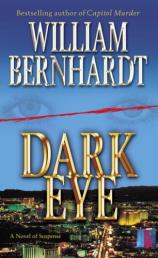
Dark Eye


Review
Dark Eye




When one thinks of William Bernhardt, one almost immediately thinks
of Ben Kincaid, Bernhardt's Tulsa, Oklahoma attorney who does a
poor job of running a law firm but is a vociferous and forceful
advocate. Kincaid has been Bernhardt's primary focus for the past
several years, and as a result, his readership might be forgiven
for forgetting that Bernhardt has written a number of stand-alone
novels as well. DARK EYE, his latest novel, is one of these ---
though it may well be the beginning of a new series, and his best
work to date.
DARK EYE introduces Susan Pulaski, a Las Vegas police psychologist
who is reeling from the sudden death of her husband. Pulaski is
self-medicating with alcohol, a process that results in a fateful
action and leads to her losing literally everything she holds dear,
not the least of which is her job. When a brutal murder takes
place, however, police chief Robert O'Bannon reluctantly retains
Pulaski as an independent consultant due to her superior talent as
a behaviorist.
Things take a dramatic and interesting turn when O'Bannon's son
Darcy becomes involved in the case. Darcy, in his mid-20s, is
afflicted with autism, and while he is socially awkward, he touches
a chord with Susan on a personal and professional level. Darcy's
unexpected talents include eidetic memory, incredible math skills,
and an uncanny ability to solve puzzles. As the brilliant but
brutal and disturbed murderer strikes again and again, Darcy and
Susan become Sin City's only hope of stopping his reign of terror
--- one that he plans to bring to an apocalyptic climax with a
terrible act of destruction.
DARK EYE reads as if Bernhardt wrote it while typing with one hand
and holding a stopwatch in the other. The novel's point of view
changes regularly back and forth between Pulaski and the murderer,
with occasional, manic commentary from Darcy. This technique would
have resulted in confusion in the hands of a lesser writer;
Bernhardt, however, skillfully delineates his characterizations so
that such confusion is non-existent and the narrative flows move
forward, and together, at a rapid rate.
Though DARK EYE would seem a daunting read at almost 500 pages, it
moves along more smoothly and quickly than many books half its
length. The contrasts between Pulaski and Darby accentuate their
common ground, and Bernhardt (bless him) seems to leave the
possibility open for another professional collaboration between
them in the future. Bernhardt, who already has a winning
protagonist going with Kincaid, has hit the bull's-eye once again.
Highly recommended.
Reviewed by Joe Hartlaub on December 29, 2010