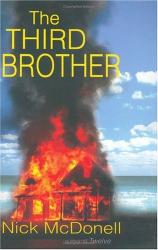
The Third Brother


Review
The Third Brother




Young and passionate authors, celebrated for their raw and fiery
prose, are often allowed to get away with less-than-skillful
technique, hole-ridden plots, unrealistic characters and messy
dialogue. Authors whose first books are published before they can
legally drink are lauded (and rightly so) just for being so good at
such a young age. With the publication of their subsequent works
comes the questions of whether they can transcend their youthful
literary style, whether their style and technique has matured,
whether they have a viable literary voice, and whether their fame
and recognition was solely reliant on their youth.
With the publication of his second novel, THE THIRD BROTHER, Nick
McDonell faces just such a test. His debut work of fiction, TWELVE,
which was hailed as "fast…relentless" and "a beautifully
tragic and unsettling story," launched the then-17-year-old author
headlong into a kind of literary celebrity that recalled the
reception of LESS THAN ZERO by Bret Easton Ellis in 1985. In both
cases, the praise of the novel was inextricably bound up in the
youth and youthful voice of its author. Ellis managed to outgrow
that initial swoop of fame and prove to be more than just a
transient literary fad. With THE THIRD BROTHER, McDonell shows
promise enough to follow in Ellis's footsteps and establish himself
as something more than just a 17-year-old flash in the pan.
The novel begins with blue-blooded, Harvard-educated Mike's forays
into the drug-addled hippie hangouts of Bangkok, Thailand, where he
is on assignment for his internship in Hong Kong. Ostensibly there
to infiltrate the scene, he also has been sent by his boss --- his
father's ex-Harvard chum --- to undertake the task of tracking down
an old roommate, a close friend and an ex-reporter named
Christopher Dorr, whose history with Mike's father and their
close-knit circle of college friends is thorny and convoluted. Dorr
had gone to Bangkok to research a story and never returned,
dissipating into a sultry and debauched world.
What Mike discovers in Thailand --- about his father, about Dorr,
and about himself --- is enough to throw his once-stable conception
of identity, of family, and of good versus evil completely
off-kilter. And Mike's struggle with, and final acceptance of, the
closest truth he can find is well-depicted. We see the initial
Mike, a serious but coddled young man who is accustomed to easy
answers, face ugly truths about human nature and human instinct. We
see those truths change him, but in a way that is natural and
steady, and never forced.
When we meet up again with Mike, his parents have died in a fire,
the work of his always-troubled older brother Lyle. Lyle has
descended into a kind of madness, and Mike has transferred to
Columbia to look after him. Mike and Lyle's story begins and ends
on September 11, 2001. Any writer who attempts to make use of that
day in their work faces the inevitable allegations of literary
manipulation --- of attempting to milk an instant so full of
national pathos that the author can lazily fall back on the
emotions it induces in readers and imagines there is no need to
create any with his or her words.
Yet McDonell evades this accusation simply by presenting Mike's
life as relatively gloomy even before the first plane hits. The
collapse of the towers, the chaos in downtown New York, and the
panicked, nervy journey that Mike makes downtown to see his brother
are all written at a kind of frantic pace. McDonell captures the
breathless fear, the seeming absurdity and need for movement ---
for action of any kind --- that that day invoked. As the novel
propels itself to a climactic finale, the delusions of Lyle echo
the madness of the world, made suddenly very real to a
once-sheltered nation. And the capacity for evil that America
suddenly must bear witness to echoes Mike's own revelatory
experience in Thailand.
The novel is divided into three sections. The first, in Thailand,
takes place over about a week. The second, in New York City,
details the events of just one day. The third takes place a year
later and darkly presents the consequences of the first two. All
three are made up of quick --- often less than three-paged ---
chapters. All are interspersed with a series of flashbacks to
Mike's childhood and the events that culminate in his parents'
deaths. Thus, THE THIRD BROTHER is rather technically complex ---
asking the reader to travel with Mike's subconscious back and forth
in time, to jump from the laconic heat of Thailand to the
rapid-fire events of September 11th and beyond, and yet to still
remain engaged. McDonell succeeds in holding his reader to the
potentially unwieldy story with his uncanny ability to render
scenes and places with simple language and direct sentences.
It is in describing a very specific scene --- a backyard in the
slums of Bangkok, or the 24-hour bar of a sleazy hotel --- that
McDonell proves his staying power. His skill lies in his very real
ability to bring his reader into the world on the page. It is to
McDonell's credit that he doesn't try to infuse his prose with
flowery descriptions and complicated sentences; it bespeaks a kind
of self-assurance that, for a 21-year-old, is both unsurprisingly
age-appropriate and surprisingly earned. He is a talented writer
who will keep getting better --- and luckily we are along for the
ride.
Reviewed by Jennifer Krieger on January 23, 2011


The Third Brother
- Publication Date: August 1, 2005
- Genres: Fiction
- Hardcover: 288 pages
- Publisher: Grove Press
- ISBN-10: 080211802X
- ISBN-13: 9780802118028