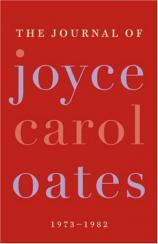
The Journal of Joyce Carol Oates 1973-1982


Review
The Journal of Joyce Carol Oates 1973-1982




People write journals for different reasons, which are usually
not created for public consumption --- at least not while the
writer is still alive. Nevertheless, this phenomenon has been known
to happen, and THE JOURNAL OF JOYCE CAROL OATES 1973-1982 is one
such book. Oates is considered the most prolific American writer to
come out of the 20th century and move seamlessly into the 21st. If
nothing else, this journal humanizes her, offering readers further
understanding of the woman, the writer, her love of teaching and
her body of work.
In “A Note on the Text,” editor Greg Johnson explains
why the 10 years between 1973 and 1982 make up the entries chosen
to create THE JOURNAL OF JOYCE CAROL OATES: the magnitude of
Oates’s “4,000 single-spaced typewritten pages”
is too much of a project for an editor to complete in a timely
fashion. With this in mind, he chose one year of “the
uniformly high quality…the journal entries…[which he]
intended to provide an accurate view of Oates’s primary
concerns” at that time in her writing career. These pieces
“focus on her work, her writing process, and philosophical
concerns.” However, some of her very personal experiences and
interactions with family, friends, colleagues and students have
made their way into this truncated version of her journal.
In her Introduction, Oates tells readers that she actually began to
keep a journal in 1971 when she was in London and feeling somewhat
homesick. “…This journal seemed to me at the start a
haphazard and temporary comfort of sorts, that would not last
beyond [that particular time] yet, astonishingly…the journal
has endured, and is now thousands of pages housed in the Syracuse
University Library Special Collections. My understanding with
myself [was] that the journal would remain haphazard and
spontaneous…never revised or rethought; it would be a place
for stray impressions and thoughts that shift through our heads
constantly; [it] would be a repository…for experiences and
notes for writing.”
The Introduction goes on to explain how Oates rationalized,
ruminated upon, questioned and analyzed the entire process of
journaling. She wonders if she will be too exposed if her journal
is published. Will the public read it and somehow sense a blurring
of her fiction and these entries? If a journal is considered a
private place, it is transformed into something else when others
read it…one of “the risks of
journal-keeping.”
She continues her comments: “What I have seen of this
edited/abridged journal, so capably presented by Greg Johnson,
affects me too emotionally to make its perusal rewarding:
revisiting the past is like biting into a sandwich in which
you’ve been assured, there are only a few, really a very few,
bits of ground glass.” She goes on to opine upon the reasons
why she feels this way: “Does the uncensored journal reveal
too much of me? Does the journal of the 1970s/1980s return me to a
time in which…my parents were alive?” What? Oates has
not read the published version of her journal…or at least she
has not read all of it. When she talks about a “glass
sandwich,” readers will have a visceral reaction that will
provoke them into thinking about having themselves outed in what
they had begun as private writing.
Every journal, regardless of its author, will be a collage of
memories, dreams, desires, self-regard, internal turmoil, petty
arguments, warm reconciliation, satisfaction and a whole host of
personal experiences seemingly of import only to the author.
However, journals cannot help but offer readers a window into the
writer’s personality, a critique on her/his work so far,
questions about her/his status in society: as a person, as a
professional, as a careerist and, in this case, as a writer and
teacher. Reputation alone is not enough to sustain the ego of
talented people, and this drives them to keep working. Their fans
often desire more; they want to understand a body of work produced
by the recipient of their ardor, offered in a way different from
formal biography or autobiography.
THE JOURNAL OF JOYCE CAROL OATES 1973-1982 is rich in personal and
happy reminiscences about her husband, her parents, her joy in
gardening, her passion for entertaining, her respect and great
regard for fellow writers, and other luminaries she has known
and/or continues to see. She is generous and humble. In assessing
her life in 1981, about eight months after completing ANGEL OF
LIGHT and A BLOODSMOOR ROMANCE, she writes: “How gracefully
things are taking shape, financial, professional, otherwise…
In all, a lovely day. Amen.”
But not every entry is as bright as this one. An intruder invaded
her office and “thrust something at me, a tiny package. A
razor blade in it, I’m led to believe.” Another
encounter with violence occurs in the form of a tongue-lashing:
“You’re very anti-man, aren’t you?”
(“must be confusing me with the feminists.”) Oates
writes in her journal: “The pointlessness of violence…
Not simply for the criminal, but for the victim. I don’t
think I will, or could, learn anything from the experience. Or
could I?”
Perhaps she did. Oates speaks in a very American voice and imbues
her writing with myths, history, family, ideas and ideals
associated with the suburban, urban, academic, political and street
images of the landscape of the United States. Some of her books are
overtly violent, while others use violence as a device to make a
larger statement about the culture we inhabit. Yet she never
preaches nor does she knock the reader over the head with
potentially vile ideas.
As a matter of fact, when she talks about writing, the process of
writing, the formation of characters, the flow of dialogue, the
choice of setting, the pace of the plot and in what century or
universe the book resides, she concludes: “If I wonder where
my personality really exists, in what form it best expresses
itself, the answer is obvious: in the books. Between hard covers.
Hard covers. The rest is Life.”
Reviewed by Barbara Lipkien Gershenbaum on January 22, 2011


The Journal of Joyce Carol Oates 1973-1982
- Publication Date: October 1, 2007
- Genres: Nonfiction
- Hardcover: 528 pages
- Publisher: Ecco
- ISBN-10: 0061227986
- ISBN-13: 9780061227981