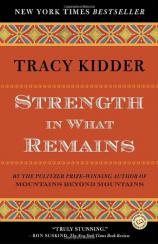
Strength in What Remains: A Journey of Remembrance and Forgiveness


Review
Strength in What Remains: A Journey of Remembrance and Forgiveness




The latest work from Pulitzer Prize-winning journalist Tracy
Kidder is a stirring account of one man’s remarkable flight
from genocidal terror in his homeland of Burundi to the United
States and then back home to confront the burdens of memory and
reconciliation. The journey of Deogratias (“Deo”)
traverses the depths of human depravity and the most exalted
heights of altruism and grace.
Kidder’s account encompasses three narrative strands. The
first chronicles Deo’s arrival in New York in 1994 with $200
in his pocket and even less command of English, and his slow, often
painful assimilation into Western society. Deo is befriended by an
airport baggage handler who leads him to an abandoned Harlem
tenement on whose façade is fittingly scrawled the word
“PEN.” Eventually abandoning the squalid conditions
there to take up residence in Central Park, Deo has the good
fortune to win the friendship of Sharon McKenna, a former nun he
meets while delivering groceries (a job for which he earned $15 a
day for 12 hours work) to the rectory of the Church of St. Thomas
More on the Upper East Side.
In a series of events so improbable as to partake of the quality
of a fairy tale, Sharon helps Deo find a home with Charlie and
Nancy Wolf, a sociologist and artist in SoHo, where he spends the
next seven years, haunted by nightmares of his homeland.
“Again and again, on the perimeter of sleep," Kidder writes,
"he was visited by sudden vivid images, of machete and flesh, and
by those dreams in which, sooner or later, he had to run and
couldn’t move.” During this time he gains admission to
Columbia University where he studies philosophy in the hope of
fathoming the mystery of human wickedness, enrolls in the Harvard
School of Public Health, meets and works with Paul Farmer, the hero
of Kidder’s book MOUNTAINS BEYOND MOUNTAINS, and eventually
is accepted at Dartmouth Medical School.
The second and most powerful section of the book turns back to
recount Deo’s harrowing flight from the Burundi hospital
where he worked as a third-year medical student and his narrow
escapes from the gangs of machete-wielding Hutu
genocidaires. Deo is a member of Burundi’s Tutsi
minority, and Kidder’s account (including a brief historical
afterword) reveals both the roots and the absurdity of those
pseudo-ethnic divisions. For six months Deo is on the run through
the mountains and valleys of Burundi, at every step encountering
scenes of unspeakable horror, like the wide-eyed baby who stared at
him from its dead mother’s breast. “Survival simply had
its own momentum,” Kidder starkly observes. Deo eventually
was led by a Hutu woman to a camp in Rwanda, where 300,000 of his
countrymen sought refuge. In the end, some 50,000 Burundians were
massacred in this orgy of violence, although that bloodshed soon
would be eclipsed by the slaughter in neighboring Rwanda that
followed the next year. In these pages, Kidder does an
extraordinary job of channeling Deo’s voice, capturing the
terror that beset him as he fled:
“He headed to the southwest, along the valley of the
Mubarazi, keeping to woods and brush and tall grass and avoiding
all roads. In places, the river’s shallow waters seemed all
but dammed with bodies and the valley was littered with them, the
corpses and feasting dogs thickening as he approached Kibimba,
where just before sunset he saw smoke rising from a building on a
hilltop. It was his cousin’s school.”
In the final section of the book, in June 2006 Kidder follows
Deo to Burundi to watch his protagonist labor to establish a
clinic. It’s a land of crushing poverty (the per capita GDP
is $83) and rampant disease, where patients who cannot pay their
bills are imprisoned without treatment in hospitals until family
members can find the money to free them. Their journey is a
powerful one, author and subject visiting endless memorials to the
genocide that wiped out members of Deo’s family and drove him
from his home. Along the way, Kidder raises provocative questions
about the power of memory and the improbable way victims of
genocide can summon the will to forgive, contrasting the Western
notion that it is healthy to “flush out and dissect
one’s memories” with his feeling that “there was
such a thing as too much remembering, that too much of it could
suffocate a person, and indeed a culture.”
Although less sweeping in scope, STRENGTH IN WHAT REMAINS stands
as a worthy companion to WE WISH TO INFORM YOU THAT TOMORROW WE
WILL BE KILLED WITH OUR FAMILIES, Philip Gourevitch’s
horrific account of the Rwandan genocide. What gives this book its
undeniable power is the intense and deeply personal story that lies
at the heart of Tracy Kidder's compassionate telling.
Reviewed by Harvey Freedenberg ([email protected]) on January 23, 2011


Strength in What Remains: A Journey of Remembrance and Forgiveness
- Publication Date: May 4, 2010
- Genres: Biography, Nonfiction
- Paperback: 304 pages
- Publisher: Random House Trade Paperbacks
- ISBN-10: 0812977610
- ISBN-13: 9780812977615